

Standard Pallet vs Custom Pallet: Which Should I Choose? - Nejoum Al Sahil Carpentry
Introduction
Choosing the right pallet can affect product protection, warehouse efficiency, transportation, and overall logistics costs . Standard pallets offer availability and lower upfront cost, while custom pallets address specific product dimensions and handling requirements. The right option depends on your product and supply chain rather than simply choosing the cheapest pallet .
What Is a Standard Pallet?
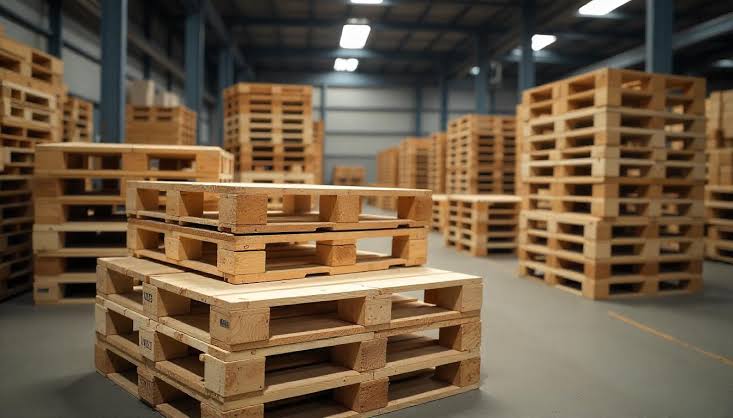
A standard pallet is mass-produced to commonly used dimensions and load capacities. In North America, the most common size is 48×40 inches, widely used in retail and consumer goods . These pallets are designed for general freight where products are uniform and handling conditions are predictable .
Advantages of Standard Pallets
Standard pallets are widely available and easier to source, often at lower cost. They work well for stable loads, common carton sizes, and conventional racking, and are familiar to warehouses and carriers .
Limitations of Standard Pallets
Standard pallets can create hidden costs when products have unusual dimensions. Overhang leads to damaged corners, while excess deck space wastes shipping volume . Poor fit increases product damage, requires extra dunnage, and may cause handling issues on automated lines .
What Is a Custom Pallet?
A custom pallet is designed around specific product or operational requirements . Customizations include length, width, height, deck board spacing, stringer placement, entry points, reinforcement, and special cutouts . Custom pallets are commonly used for irregular footprints, heavy loads, high-value goods, and export shipments requiring ISPM 15 compliance .
Advantages of Custom Pallets
Custom pallets eliminate inefficiency by matching the product precisely. They reduce load movement and vibration during transport, lowering damage rates . Better fit improves container loading and cube utilization, reducing freight costs . Built-in compliance with export regulations reduces delays and fees .
Limitations of Custom Pallets
Custom pallets typically have higher upfront cost—often 30–80% more than standard options depending on complexity . They may require design work, prototyping, and longer lead times .
Key Differences at a Glance
Availability: Standard pallets are widely available; custom pallets require production time.
Cost: Standard pallets have lower upfront cost; custom pallets cost more upfront but may deliver lower total cost over time.
Design Flexibility: Standard pallets offer none; custom pallets provide full customization.
Product Fit: Standard pallets may leave overhang or wasted space; custom pallets match product dimensions precisely.
Automation Compatibility: Standard pallets may not match conveyor or AGV requirements; custom pallets can be built to tight tolerances for automated systems .
When to Choose a Standard Pallet
Standard pallets may be the right choice when your products fit common dimensions and your logistics system supports them . Consider standard pallets for uniform loads, domestic distribution with minimal compliance requirements, high-volume applications where margins are tight, and operations where immediate availability is important .
When to Choose a Custom Pallet
Custom pallets are more appropriate when standard options create inefficiencies . Consider custom pallets for unusual product dimensions, heavy or irregular loads, export shipments requiring ISPM 15 compliance, high-value goods where damage is expensive, and automation environments requiring precise specifications .
A Simple Decision Framework
A practical way to decide is to test a small quantity before committing to a large custom order. Evaluate product fit, stability, handling, storage, transportation, and load performance . If your product has overhang, requires excessive dunnage, or consistently suffers damage, custom pallets often solve problems that have become “normal” in your operation .
Conclusion
The choice between a standard pallet and a custom pallet depends on your product, logistics system, warehouse environment, handling requirements, budget, and order volume. Standard pallets work when your product fits common dimensions and your supply chain supports them. Custom pallets are worth considering when standard options fail to protect your product or operate efficiently . The pallet that saves money upfront can become expensive through damage, wasted space, and handling delays—so evaluate total cost, not just the purchase price .
Leave A Comment